
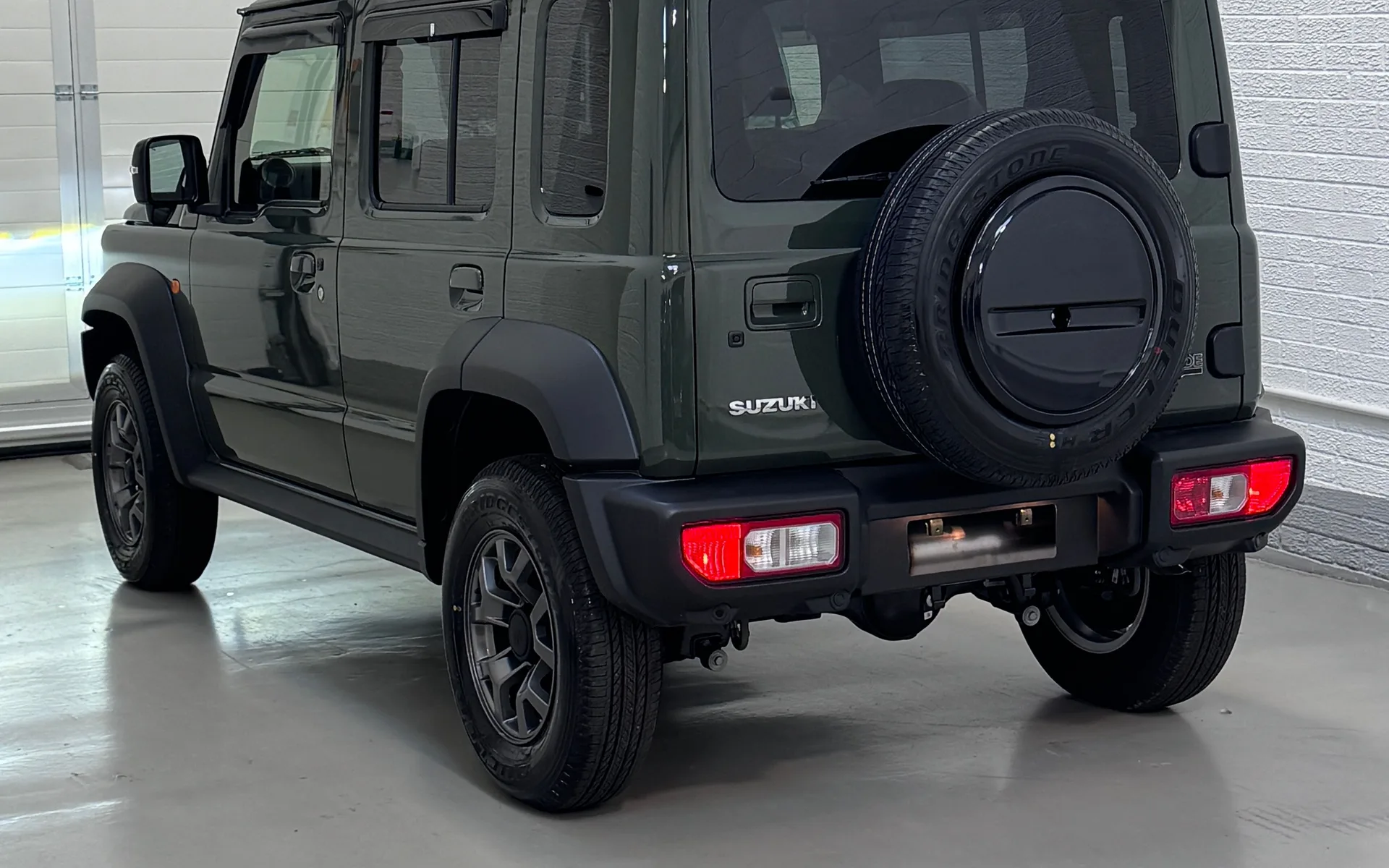
Since 15 July 2026, a car built in India can enter the United Kingdom at 0% customs duty instead of the 10% third-country rate, under the UK–India Comprehensive Economic and Trade Agreement. On a five-door Suzuki Jimny — a car built only in India and not sold new in Britain — that is worth 12% of the customs value. It is worth nothing without proof of origin, and a Jimny bought in Japan is unlikely to have it.
The short version
- The UK Trade Tariff shows a 0% preference for India on new and used passenger cars of 1,000–1,500cc from 15 July 2026 (checked 15 October 2026).
- Without a valid claim the 10% third-country rate still applies. The preference is claimed, never automatic.
- The saving is the duty plus the VAT charged on it: 12% of the customs value. Import VAT on the car itself is unchanged at 20%.
- A car bought new in India and shipped directly, with the exporter’s proof of origin, is the case the agreement is built for.
- A Jimny Nomade bought in Japan is India-built but has been registered and driven in a third country. Budget 10%.
What changed on 15 July
The UK government announced on 17 June 2026 that the agreement would enter into force on 15 July, giving traders 28 days to prepare. India’s Ministry of Commerce confirmed the same date. The UK side is implemented through The Customs (Tariff and Miscellaneous Amendments) Regulations 2026 (S.I. 2026/36), which the Trade Tariff names as the legal basis for the India preference on cars.
| Commodity code | What it covers | Third-country duty | India, from 15 July 2026 |
|---|---|---|---|
| 8703 21 90 | Used cars, petrol, up to 1,000cc | 10% | 0% |
| 8703 22 10 | New cars, petrol, 1,000–1,500cc | 10% | 0% |
| 8703 22 90 | Used cars, petrol, 1,000–1,500cc | 10% | 0% |
Source: UK Integrated Online Tariff, via the Trade Tariff API, read 15 October 2026. The same codes show a 0% Japan preference from 1 February 2026 under the UK–Japan agreement. VAT is 20% on all three.
We checked the codes that cover the Jimny’s 1,460cc engine and the neighbouring small-engine line. Other engine sizes and fuel types sit under other codes; check yours on the Trade Tariff before relying on this table.
Does this apply to your car?
It applies to a car that originates in India under the agreement’s rules, imported into the UK with a valid claim. The badge does not decide it and neither does the country you bought it in. The five-door Jimny is the clearest example: Maruti Suzuki builds it at Gurugram and reported in October 2025 that more than 100,000 had been exported, with Japan, Mexico, Australia, South Africa and Chile among the largest markets. There is no UK-market five-door, so every one in Britain is an import.
It does not apply to a car built elsewhere and sold in India, and it does not change anything for a Japanese-built car, which already had its own 0% preference from 1 February 2026.
Does it cut what you pay?
Yes, by more than the headline 10%. UK import VAT is charged on the customs value plus the duty, so removing the duty also removes the VAT that was charged on it. Using an illustrative customs value of £20,000 — a round number for the arithmetic, not a price:
| Without a valid claim | With a valid India claim | |
|---|---|---|
| Customs value (illustrative) | £20,000 | £20,000 |
| Duty | £2,000 (10%) | £0 (0%) |
| Import VAT at 20% on value plus duty | £4,400 | £4,000 |
| Duty and VAT together | £6,400 | £4,000 |
Our arithmetic, using the UK Trade Tariff rates read on 15 October 2026. The difference, £2,400, is 12% of the customs value whatever the value is.
The customs value is the price plus transport and insurance to the UK border, and a rupee or yen price is converted at HMRC’s published monthly rate, which can sit some way from the market rate — as we reported when HMRC’s October yen rate moved 3.4%. For a VAT-registered dealer, the VAT is recoverable, so the real gain is the duty alone: 10%.
The proof of origin is the whole claim
A preference is claimed by the importer, on the basis of origin proof made out by the exporter in the form the agreement sets. The government’s guidance to UK traders describes the origin declaration as the document that confirms where goods come from, made out by the exporter or producer. The importer is the one who answers for the claim if it is checked.
Two conditions catch cars specifically. The guidance says goods must remain under customs control if they transit a third country, and must not be processed outside the UK or India. A car bought new from an Indian dealer and shipped directly fits that shape. A car bought anywhere else, or one that has had a life in between, may not.
On the record
- The UK–India agreement entered into force on 15 July 2026.
- The UK Trade Tariff shows 0% for India on new and used petrol cars up to 1,500cc from that date.
- The third-country rate is still 10%, and import VAT is still 20%.
Still not established
- Any HMRC guidance written for used cars under this agreement. We found none.
- Whether an India-built car registered and used in a third country can ever qualify. On the government’s own summary of the rules, it looks unlikely.
- How readily Indian dealers and exporters will issue origin declarations for single private cars.
The Jimny Nomade bought in Japan
Japan imports the five-door from India and sells it as the Jimny Nomade. It is India-built, so it cannot use the Japanese preference. And having been sold, registered and driven in Japan, it has not stayed under customs control in transit. Plan on 10% unless HMRC tells you otherwise in writing.
Is your car still allowed in?
Nothing changes. The agreement moves the duty, not the approval or registration rules. A five-door Jimny is under ten years old, so it still needs an Individual Vehicle Approval; the DVSA’s published route for using an export certificate as evidence is written for Japanese-market cars, so an Indian-market car’s evidence should be agreed with the DVSA first. NOVA within 14 days of arrival, DVLA registration and vehicle tax all apply as before. Our guide to importing a Suzuki Jimny to the UK works through each step.
Should you move now or wait?
There is no deadline: the preference has no end date in the tariff. The reason to act is not urgency but sequence. Origin proof has to be made out by the exporter for the shipment, so it is settled before the car sails or not at all. If you want a five-door and the 12% matters, buy new in India, ship directly and ask for the origin declaration before you pay. When you are ready to price one, you can import an India-built car with the landed figure itemised before you commit.
- Buying a five-door for yourself: compare a new Indian car with a 0% claim against a Japanese Nomade at 10%. The Japanese car has Japanese-market equipment; the Indian one has the lower duty.
- Buying stock as a dealer: your VAT is recoverable, so the claim is worth 10% of the customs value per car — and you hold the origin evidence for HMRC if it asks.
Who benefits from the headline?
“Zero duty on Indian cars” is the version that travels, and it suits anyone selling Indian-built cars into Britain, including us. The accurate version is narrower: zero duty on a car that originates in India and arrives with proof. A seller who quotes 0% on a car without saying who makes out the declaration has quoted you a figure you will defend alone.
Rates are from the UK Trade Tariff as read on 15 October 2026 and can change. A preference depends on origin evidence and on the agreement’s conditions, which HMRC may verify after import. Confirm the position for your car with HMRC before you commit.
Sources
- Commodity 8703 22 90 00 — used passenger cars, 1,000–1,500cc — UK Trade Tariff (HMRC)
- The countdown begins: UK-India FTA enters into force on July 15th — GOV.UK
- UK–India CETA: rules of origin — UK Department for Business and Trade
- The Customs (Tariff and Miscellaneous Amendments) Regulations 2026 (S.I. 2026/36) — legislation.gov.uk
- India and the United Kingdom: CETA set to enter into force on 15th July 2026 — Press Information Bureau, Government of India
- Maruti Suzuki Jimny 5-Door crosses 1 lakh exports — The Week